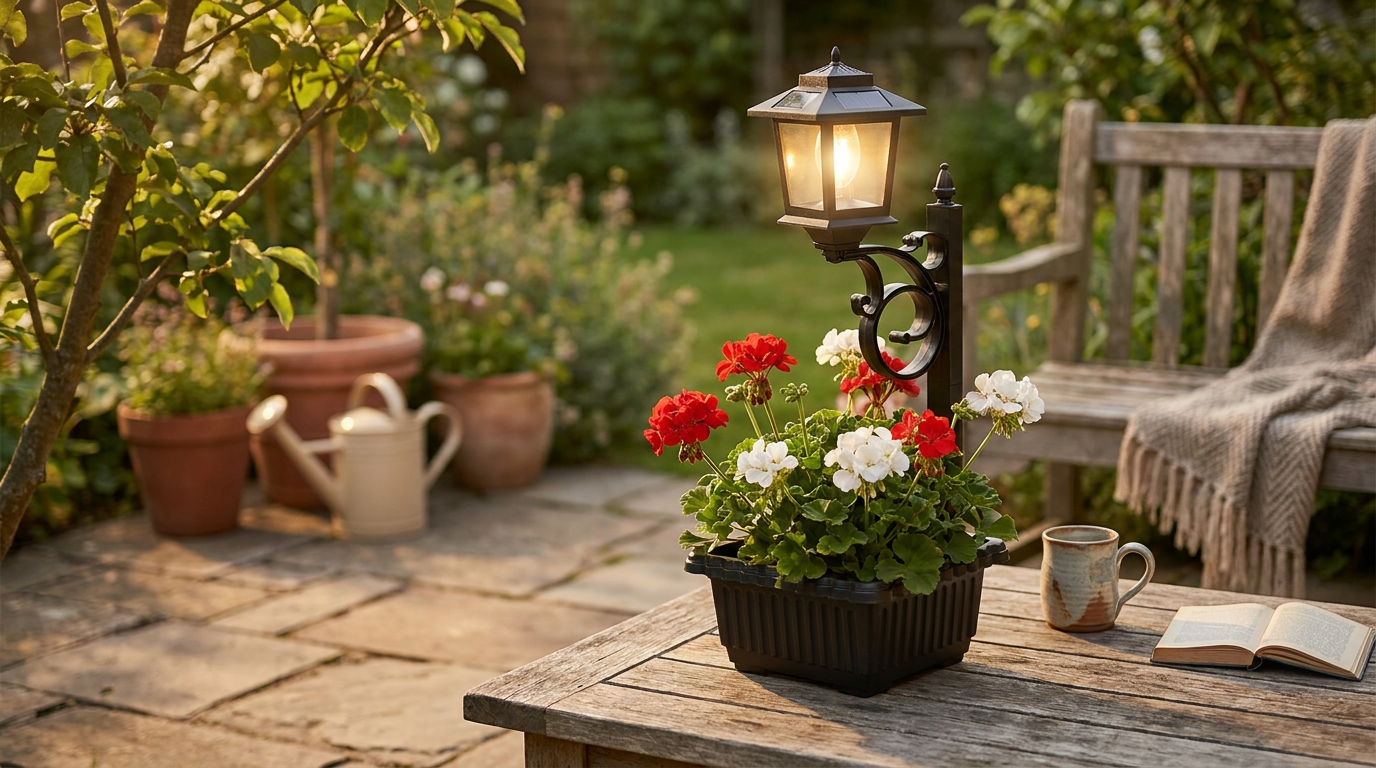
Solar Planter Lamps: A Design Flaw Hiding in Plain Sight
 Maya ChenContributing Editor
The conventional wisdom paints solar planter lamps as a brilliant two-in-one solution for wire-free garden lighting. They are marketed as the epitome of convenience: a decorative planter and an autonomous light source in a single package. This assessment, however, conveniently ignores a fundamental design trade-off. In the quest to merge a light fixture with a plant pot, the 'planter' component is often reduced to a secondary role, creating an environment that can be surprisingly hostile to healthy botanical growth.
Here's the part nobody talks about: the compromised root environment. A typical 16-inch standalone planter provides a stable soil volume for robust root systems. Integrated lamp models, by necessity, sacrifice a significant portion of this volume—often up to 30%—to accommodate battery packs, wiring, and internal supports. This restriction stunts growth, particularly for plants with deep roots. Worse, the internal electronics generate heat. During a sunny day's charge cycle and the subsequent nighttime discharge, the battery compartment can elevate soil temperature. According to the University of Georgia Extension, soil temperatures consistently above 85°F cause heat stress and root damage in many common annuals, effectively 'cooking' them from below.
Manufacturers point to drainage holes as proof of horticultural viability, but this is a reactive measure, not a proactive design. The very proximity of required water drainage to sealed electronic compartments introduces a long-term failure point through moisture ingress. This is why a meticulous approach to porch placement for solar planters is not an optional step but a critical procedure to mitigate premature system failure. The emphasis on tall, vertical structures is a valid attempt to solve a common problem, as a vertical approach to design improves light distribution across a deck or patio. Yet, this often results in a top-heavy unit with a shallow, unstable base that is ill-suited for substantial plantings.
Do solar planter lamps provide adequate security lighting?
No. Their primary function is ambient or decorative lighting, not security. Most consumer-grade units produce between 50 and 200 lumens, creating a soft glow. For context, a basic 40-watt security bulb emits around 450 lumens. These planters define a pathway or highlight a feature; they do not illuminate a large area for security purposes. Homeowners should evaluate them separately from dedicated front door landscaping lights.
Are the batteries in solar planter lamps replaceable?

Photo by Gorma Kuma on Pexels
Rarely. To achieve a weather-resistant rating, manufacturers typically seal the lithium-ion battery pack and control board within the lamp housing, making them inaccessible to the user. While the integrated LEDs are often rated for 50,000 hours of use, the battery's functional lifespan is much shorter—typically 2-3 years or approximately 1,000 charge cycles. When the battery inevitably fails to hold a charge, the entire, often expensive, unit becomes electronic waste.
I'll change my mind when a manufacturer releases a modular design featuring a thermally insulated planter basin, a user-replaceable battery compartment that doesn't compromise soil volume, and transparent data sheets on lumen depreciation over time.