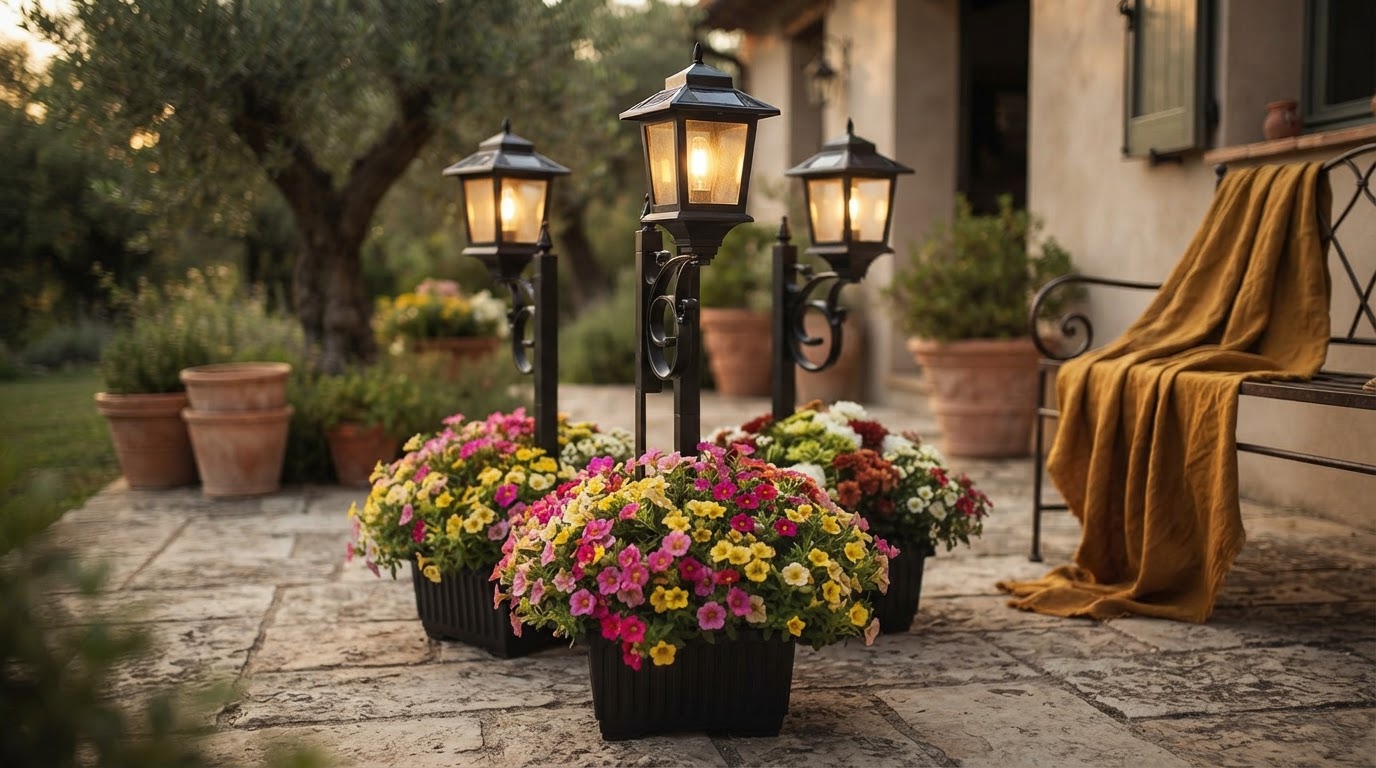
Joyoowild Price Drop Meets Solar Planter Lamp Realities
 Maya ChenContributing Editor
November 12, 2026 — The market for outdoor illumination saw a significant price shift this week as Amazon discounted the Joyoowild 74-inch 3-Head Solar Lamp Post to $59.99. While the 50% price reduction aims to capture budget-conscious homeowners, the hardware specifications suggest a trade-off in charging efficiency and placement flexibility.
The conventional wisdom says that a larger fixture at a lower price point represents superior value, but the math on solar conversion often tells a different story. According to Slickdeals.net, the Joyoowild unit reached its $59.99 price point via a 50% promotional code, HLN6PO2F, applied to an original $119.99 MSRP. While this looks attractive on a spreadsheet, consumers must weigh the 74-inch height against the stability of a plastic planter base. Here's the part nobody talks about: a three-head lamp post creates a significant wind sail effect that small-volume planters struggle to ballast without heavy stone filler.
By contrast, the HOODINK 2 Pack Solar Planter Lamp from Solar Planter Lamp prioritizes a lower center of gravity and localized charging. Each HOODINK unit utilizes 4 high-performance solar panels to achieve a full charge in 6-8 hours. This configuration supports 8-10 hours of 3000K warm light, a specific duration that many oversized multi-head units fail to hit during winter months when daylight hours are restricted. When considering installation methods for solar posts, the HOODINK’s dual-setup option—allowing for ground staking or wall mounting—offers a utility that fixed 74-inch posts cannot replicate.
Run the math: the Joyoowild discount reported by Slickdeals.net brings the cost per lamp head down to roughly $20, yet the energy draw of three lamps on a single pole often leads to premature dimming. For those focused on long-term weather resistance, the HOODINK’s IP44 waterproof rating and ABS construction provide a baseline for year-round performance. Furthermore, optimizing solar panel placement is significantly easier with modular units than with a single, towering fixture that requires a perfectly unobstructed 360-degree radius.
Expert tip: When using solar planters, always prioritize the lux-to-charge ratio over total height. A 74-inch post requires significantly more structural integrity; if you choose the taller Joyoowild model, ensure you use at least 15 pounds of drainage rock at the base before adding soil to prevent tipping. For those prioritizing energy-efficient dusk-to-dawn sensors, smaller, dedicated panels on each light usually offer more consistent trigger points than a centralized sensor.
I'll change my mind when budget multi-head units provide independent battery banks for each lamp head to prevent total system failure from a single shaded panel. Until then, the modular approach remains the more logical investment for reliable light.